The Founder's Notebook: Alessandro Scarcella
Made at WeWork Founder Exclusive | 17 Sep 2026 | 7 min read
By: Natasha Fracchiolla, WeWork Story Correspondent
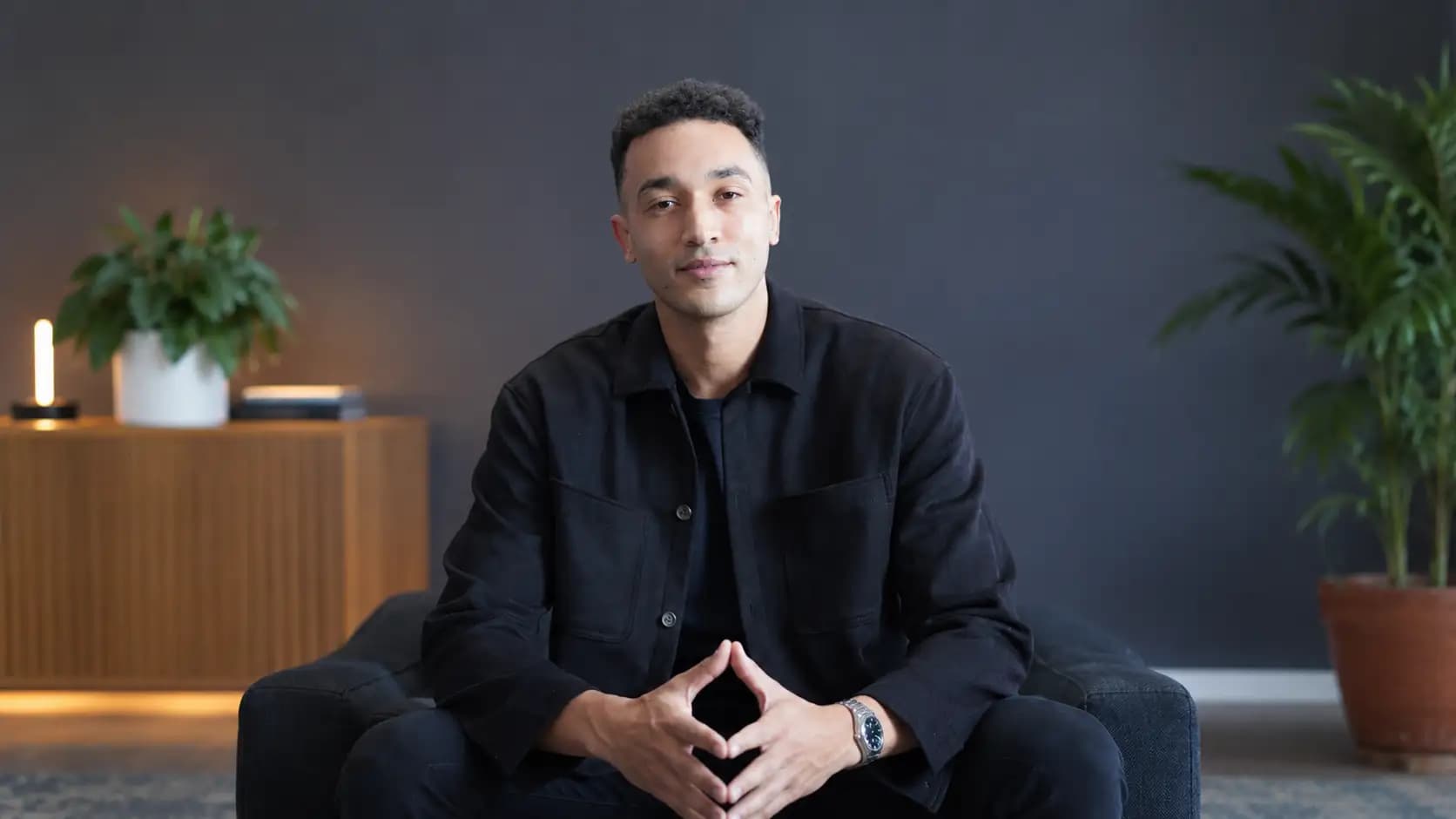
Alessandro Scarcella, co-founder and CEO of Adjunct, at WeWork 155 West Street, Sandton.
Meet the AI guy who builds his business by conviction and believes there can be nothing worse than wasted human potential. His name? Alessandro Scarcella. His start-up? Adjunct. His reason for being? To be loyal, to remain determined, to be entirely, irrevocably useful.
In this edition of The WeWork Founder's Notebook, we get behind the AI to meet this self-driven 33-year-old entrepreneur and WeWork fully serviced private office member. For the first time here, Alessandro shares who he is, what he does and how he does it.
Some businesses start with a big bang. Others start with a weekend, a meeting room and an idea worth chasing. For Adjunct co-founder and CEO, Alessandro Scarcella, that room happened to be on Deck 4, at WeWork 155 West Street. His idea? To build tools that amplify professionals rather than replace them.
Two years in, Adjunct is one of South Africa's start-ups to watch, growing at around 25% month-on-month, and helping lawyers streamline and distil mountains of information into more effective processes.
This said, one might expect to discover an anti-social, possibly arrogant, insanely certified gadget geek behind it all. And yet, entirely the opposite. What waits for me in the room is a sharp-minded, high-octane, unassuming, modest-in-the-moment human being. A guy who grew up on Parma ham, codes like a beast on cappuccino and writes everything down, then throws it away.
About this interview: I did not only meet a switched-on Joburger on this day, with a bold entrepreneurial spirit. I met a man much bigger than this. An individual worth his salt in words; curious by nature, conviction-led by choice. He doesn't profess to have all the answers. But he does make a compelling case for backing yourself long enough to find them. And when you do, you'll believe in all you can do!
The Interview
First things first. Are you actually a lawyer?
Alessandro: I am not and as you can imagine, over the last two and a half years, we always get asked the same question, are you guys lawyers? We had the view in the early stages, that we could build the product without actually being lawyers. We just needed to understand the broader structures of law, where the data is coming from, what kind of tasks they're doing, building tools for them to apply their expertise rather than us trying to impose our expertise on the product. It's a complementary tool.
So then how did a guy who knew nothing about law end up building an AI litigation suite?
Alessandro: Great question. I get that a lot from my customers. (laughs… goes quiet… contemplates… speaks)
I had been in AI for a while, and it was clear that it was going to have a big impact on professional work. And so, the question was which industries first?
Lawyers read a lot and they write a lot. That's exactly what AI was also good at. So, law seemed like the right industry for this venture.
So, you were always in technology? How were you led to these observations?
Alessandro: I was working in AI a long time prior to Adjunct, and I've been gearing up to do something like this for a while. And so, it's always been on my radar. It was just a matter of when.
You must have known a guy, right… everyone in Joburg knows a guy?
Alessandro: I assume you are asking if I knew a lawyer? My cousin's a tax attorney. So, I built a prototype around tax law and showed it to him. And yeah, he was like "look, it's not perfect, but there's signs of hope" and that was enough for us.
You chose AI before AI was cool. Why?
Alessandro: When I first got into AI, it was 2015. At the time, it seemed like a bit of a crackpot idea, a bit of a sci-fi thing. I turned down a great grad job to go study AI. So, even back then, I had high conviction that AI was going to become a real thing in my lifetime. If I had enough patience and determination, that it would be a bet that would pay off long term.
What could you see that others couldn't quite see at the time?
Alessandro: I wouldn't frame it as what others couldn't see. I would say that people should trust their own judgment. It's easy to get crowded out by what's popular at the time or what's normal. People need to give themselves the space to trust their own judgment and observations.
"People should trust their own judgment."
— Alessandro Scarcella
On growing up. And coming last.
So, you're Italian, then?
Alessandro: Second-generation. My dad was Italian; my mom is South African. But I wouldn't say I grew up Italian. My family was fairly cosmopolitan, and I went to a very cosmopolitan school.
You got to be a pizza man though. Tell me, you're a pizza man or a spaghetti man?
Alessandro: Of course, of course. I mean, I grew up on Parma ham, so life was good.
What was your childhood like?
Alessandro: I grew up in Joburg, in a typical middle-class, lower-middle-class household. I went to good schools and have four elder siblings. I spent 10 years in Cape Town after high school and returned during COVID.
Wow, there's five of you? And you came last?
Alessandro: Yes, youngest, but the best. (The jury's out on whether he's joking!?)
COVID was a tough time for everybody, what was that transition like for you?
Alessandro: My dad had an operation during COVID, and he was staying by himself on a farm in Muldersdrift. When he came out of the hospital, I moved in to help him while he was recovering. I think being on a farm with a lot of space and fresh air was probably the best place to be during the pandemic.
It seems your dad had a big influence on you?
Alessandro: He was an incredible guy. A big part of my childhood was just trying to earn his respect, which was quite difficult to do. Towards the end of his life, we became more like brothers. I have a tremendous amount of respect for what he'd done with his life.
What did he teach you that shows up in your business today?
Alessandro: He was generally a nice guy, very affable, but he had very strong principles. And I think much is true in business. I think there's certain levels of respect and trust that's important in business.
On human superpowers.
What would you say your superpower is on your off days?
Alessandro: I don't know if I need superpowers when I'm not working.
Okay, what would you say your work superpower is?
Alessandro: If I had to identify one or two things I think I've got high levels of curiosity and determination.
What's your biggest fear?
Alessandro: Unfulfilled potential. I've got partly a fear of unfulfilled potential and then also I always marvel when I see people who've maximised their abilities. And so, it's a mixture of those two things that I just don't want to waste my time on this earth.
You write the code and run the business. Why not leave the product to someone else?
Alessandro: There's a bit of magic in being able to combine the technical and the strategic. I've always wanted to stay close to product; to work closely on the engineering side, in order to inform what the strategy of the business needs to be.
On weird workday rituals.
What does the first hour of your workday look like?
Alessandro: First thing I do is I take out a blank piece of paper and write down no more than two or three things I need to get done that day. And, over the years I've found that that's the best way to be productive. Things tend to move quickly if you can prioritise.
Are you a notebook guy?
Alessandro: Yeah, I love notes. I'm very particular about the way I do my notes. I just find it helps me think better. I never type them out. I prefer to write with a clutch pencil. I just find that it works better for me. If I'm trying to think through a problem, I'll write it out myself and then immediately throw it away.
Wait. You throw your notes away? All of them?
Alessandro: Yes. (A full body yes!) Most of the notes I throw away. So, like I said, for me it's a thinking tool more than an archive.
Any other secret work habits?
Alessandro: I don't know if this is a secret, but it's definitely quirky. If there's a piece of work that I know I'm going to have to be really locked in for, I've found that I end up listening to a single song on repeat.
I don't plan this, but there'll be a song that I feel like I've got good rhythm with. I'll repeat it once and then I'll replay it again and at a certain point I'm like, I just want to listen to this song. So, I'll just put it on loop, and this can go on for days to be honest.
(awkward silence)
Alessandro: It's a bit psychotic I know, but if it works, it works.
Let me guess, you're secretly an Elvis fan, right? (hoping he says yes!)
Alessandro: No, not at all, not in the slightest. (Bombed!)
On coffee. Lessons in business. And life at 40.
Okay, fess up your coffee vibes. How many are we talking?
Alessandro: So… right now… it's at about two or three a day. (there's more to this story) I've slowed down. (knew it!) Last year was probably the worst. (tell me more…) There were times where I was having like six or seven a day. (Gotcha!)
And where are all these devilishly good cuppas coming from?
Alessandro: Alec. (Everyone blames Alec. Psst! Find him on Deck 4!) If anyone deserves some shares in our business, it's Alec.
What matters more in a startup: intelligence, curiosity or determination?
Alessandro: I think determination in startups is probably the most important factor. Intelligence counts, curiosity counts, but determination, especially in the early days, is like the number one factor, in my opinion. There's also a bit of a will to power. You have to find a way to be useful.
You've spent five years at WeWork. You grew from a dedicated desk in Johannesburg, to an All Access member to a private office. Seems your success story is made at WeWork?
Alessandro: Absolutely. I joined WeWork during the tail end of the pandemic, working remotely for my previous employer. When I started Adjunct two years ago, there was no reason for me to leave, and there still isn't.
I want to be around people who are like-minded, and WeWork does this for me, and my business.
On leaving behind something great.
Before you leave this earth, you have one last page in your notebook: the one you don't throw away. What will you write on it?
Alessandro: Don't waste your potential. I guess another version of this is you don't know what you can achieve. You can only find out what you can be by going through the process. You have to act.